

Over the past year, we’ve received numerous calls from organizations experiencing or anticipating significant revenue disruption. For some, contracts have been canceled with little or no notice. For others, multi-year funding that once felt secure is becoming uncertain or sunsetting as government and philanthropic priorities shift. Amid political volatility and increased competition for limited resources, leadership teams and boards are asking difficult but necessary questions about their immediate course of action and long-term sustainability.
In moments like these, leaders often feel pressure to react quickly. But the most effective responses begin with a clear assessment of where the organization stands and what it has to work with.
Fio Partners developed a framework to help nonprofit leaders navigate this moment strategically. It is not designed to prescribe a single path, but to help organizations determine which path fits their circumstances and commitments to the communities they serve.
START WITH A CLEAR VIEW OF YOUR FINANCIAL REALITY
The first step is to understand the organization’s financial reality in concrete and practical terms.
Last year, did the organization break even, generate a surplus, or begin running a deficit? What does the current year look like so far? Develop a working understanding of how much revenue is coming in and how much is going out on a monthly or quarterly basis.
From there, consider how confident you are in each major funding source. Donations, grants, and government contracts all carry different levels of certainty. In periods of disruption, it’s essential to identify which sources remain reliable, which may be at risk, and how detrimental those changes would be. (Nonprofit Finance Fund and BDO have great financial scenario planning tools you can download.)
Cash runway is another critical factor. If no additional revenue were secured, how long could the organization continue operating? Also, understand whether current assets cover liabilities—and what could be liquidated quickly if needed. Together, these factors help establish the time horizon leaders have to work with—and the flexibility or urgency that comes with it.
AFFIRM WHAT THE ORGANIZATION HAS TO WORK WITH
Equally important is recognizing the non-financial assets available to navigate the moment.
One of the most significant assets is leadership itself. In our experience, the willingness of board and staff to persist as an independent organization often shapes what happens next more than any single financial indicator. Do leaders have the energy to fight for sustainability? Are they willing to rethink program models, activate staff in new ways, or seek new investors and partners? Is there an appetite for innovation? These are not secondary questions. They are central to determining what strategies are possible.
Next, consider the organization’s “mission assets”. How unique and valuable are your programs to the communities they serve and peer organizations? Are there intellectual property, competencies, specialized expertise, or infrastructure that distinguish the organization from others? Thinking in this way helps leaders clarify what they can leverage, what they must protect, and what they might be willing to let go. It shifts the conversation away from preserving everything the organization currently does and toward preserving what matters most.
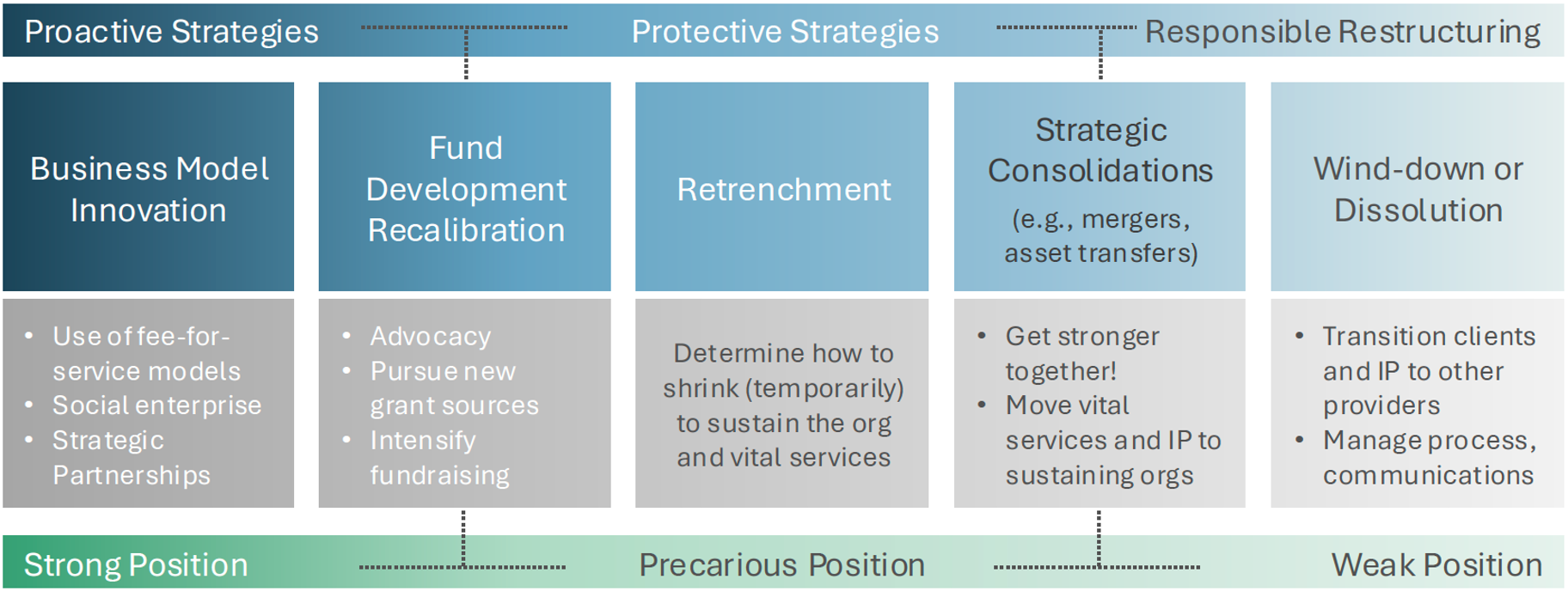
Once organizations understand both their financial position and their assets, they are much better positioned to determine how to respond to disruption. What often becomes clear at this stage is that there is no single correct response. Instead, there is a range of strategic options that correspond to different circumstances.
Organizations operating from a position of relative strength—those with stable finances, strong programs, and aligned leadership—are often able to take a proactive approach. In these cases, disruption can become an opportunity to rethink the business model through new services, earned revenue strategies, or partnerships that expand impact. Rather than simply protecting what exists, these organizations can redeploy their assets in new ways to sustain the mission over time.
Other organizations find themselves in a position where their programming remains strong and leadership is committed, but their revenue mix needs recalibration or reinforcement. Here, the focus typically shifts to strengthening the funding engine through advocacy, new grant opportunities, and intensified fundraising.
As conditions become more uncertain, some organizations recognize that they cannot continue operating at their current scale. In these cases, retrenchment can be the most responsible path forward. It involves making thoughtful decisions about which programs to sustain and which to step away from, so the organization can shrink while continuing to deliver its most essential work. Sometimes, this strategy is enough to stabilize the organization, which can then build back more sustainably over time.
Other times, leadership teams reach a different conclusion: that continuing alone may not be the best way to protect the work they care about most. In these situations, strategic consolidations—such as parent-subsidiary arrangements, mergers, and asset transfers—become important tools. The goal is not simply organizational survival, but the preservation of vital services and expertise within a structure that can sustain them.
At the far end of the continuum, some organizations determine that the environment no longer supports their continued operation. In these cases, a thoughtful wind-down or dissolution can ensure staff, programs, and clients transition responsibly and that mission impact continues in other forms.
MOVE FORWARD WITH INTENTION
Revenue disruption is very challenging, but it bears repeating that across all these pathways, leaders shape what happens next.
Financial indicators may narrow or widen what is possible, but they do not determine what leaders choose to do. Boards and executive teams ultimately decide whether to persist, adapt, partner, or conclude this chapter of their work. For this reason, responding to revenue disruption is not only a financial exercise, but also a governance and leadership exercise. It requires organizations to clarify their commitments and appetite for change, and envision how to sustain the mission in whatever form makes the most sense for the future.
